

By Sara Hinds
Pulling an all-nighter without caffeine seems impossible, but so does combing through a data set with around 100,000 observations and 60+ variables to the untrained individual.
And four Doane students accomplished both simultaneously earlier in the semester as part of the 7th National Big Data Health Science Case Competition.
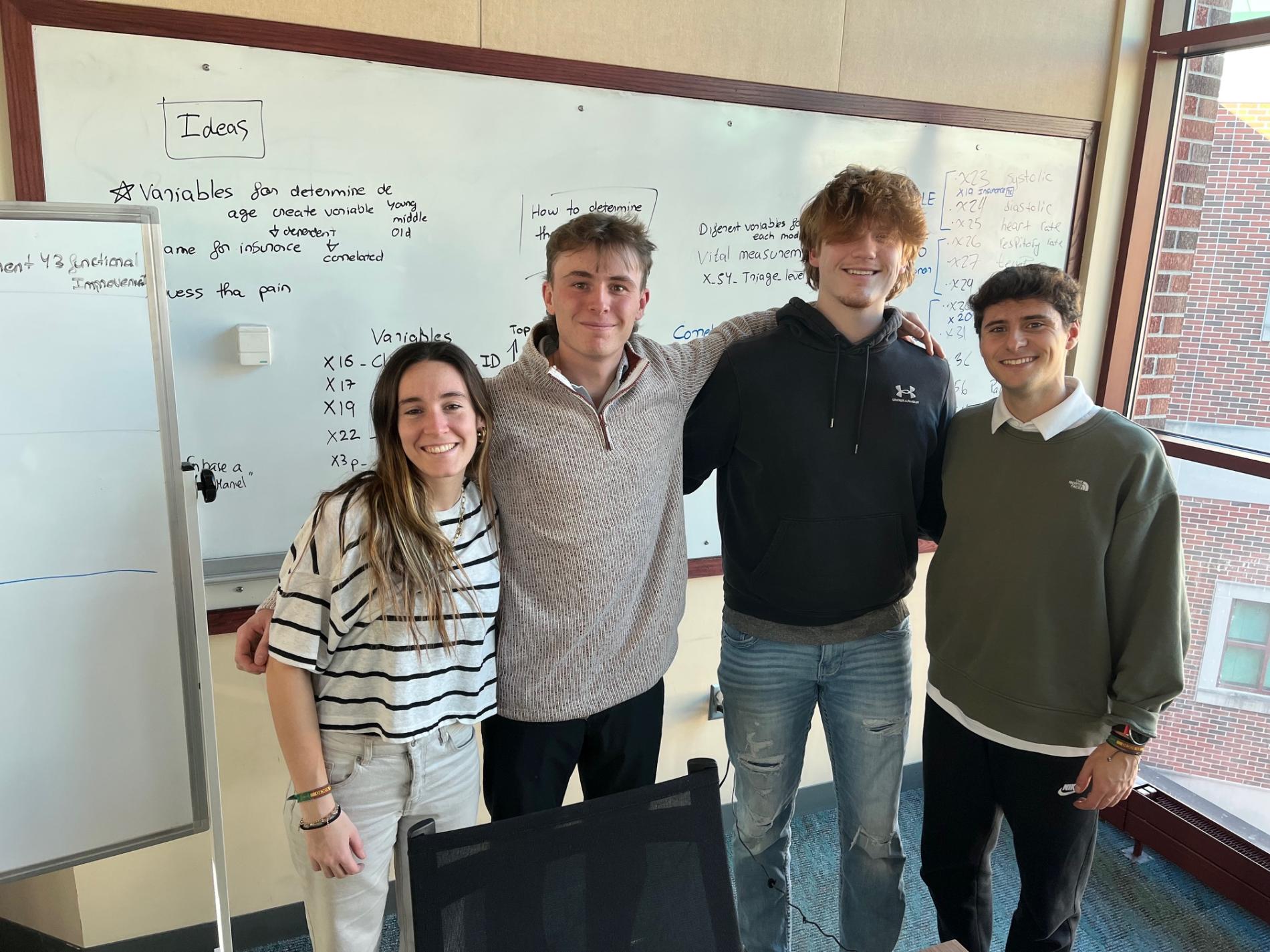
“This was a 24-hour virtual competition and the students worked from 11 a.m. Friday, February 6, until 6 a.m., Saturday, February 7 without sleeping!” associate professor Peggy Hart said. “Over 30 teams competed but Doane's ‘Vital Signs’ team was one of the only teams made up of all undergraduates.”
‘Vital Signs’ consisted of juniors Mathis Fortin (Ottawa, Canada) and Conor Gilreath (Winlock, WA) and seniors Alejandra Prat (Barcelona, Spain) and Pablo Rodriguez (Valladolid, Spain). All are working toward a major or minor in math & data analytics.
Rodriguez said he relied on the tools and methods he learned in class to clean, organize and present data. It was these “little wins” — cleaning variables, finishing visualizations, etc. — that kept him and his peers awake and excited throughout the competition. On top of it all was the realization that they were working with real data to solve a real problem.
“How can I apply those things to real life, and how can I affect real people, and how can I make a person take a vital decision, just on my math? So that was really cool,” Rodriguez said of the competition. “In my future, I just want to keep going. I'm already into other universities to do my master’s in data science, so I just want to keep learning and developing my skills in data science and data analytics.”
Fellow senior Prat is eyeing a different career path after graduation, interior design. She scooped up a minor in math & data analytics because, well, why not? Why rely on others when Prat could learn for herself?
“I know that nowadays everything is data,” Prat said. “Data is so important and with the data you can analyze and discover amazing and important things.”
Once Prat and her group members finished the competition portion Saturday morning, they snuck in a few hours of sleep before presenting their findings to a panel of academic and industry professionals.
While Vital Signs didn’t place as a top-three finalist, they relished the opportunity to apply their skillsets honed in the classroom to solve a real problem, not just pass a test.
“We were excited,” Prat said. “We know that it’s a good thing for our future to learn and get this experience.”


